


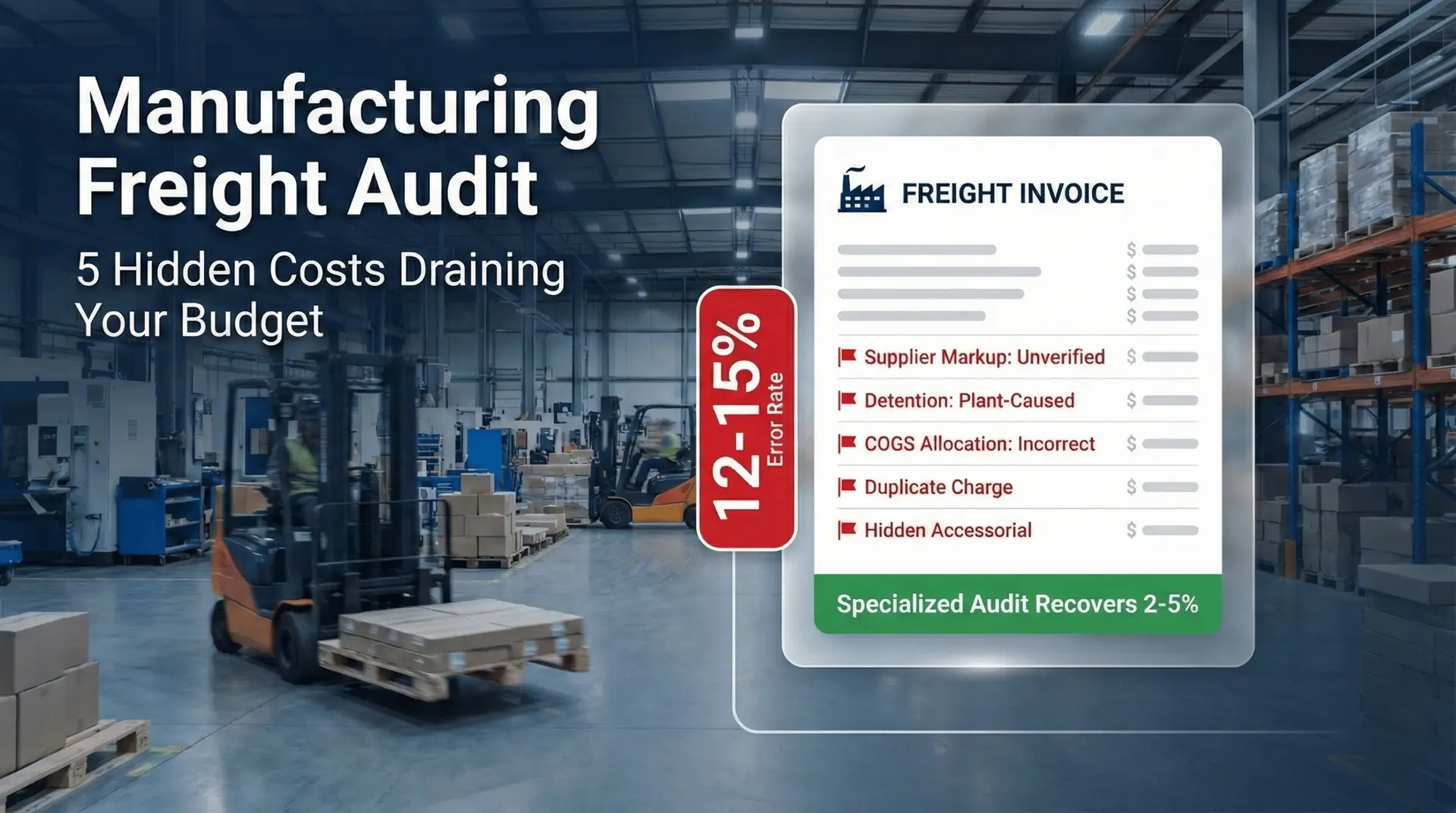
Manufacturers face five categories of hidden freight costs that generic audit programs miss entirely. These costs span invoice errors, inbound vendor markups, detention charges caused by plant operations, inaccurate freight allocation to products, and trapped working capital in payment cycles.
Manufacturing accounts payable departments processing freight invoices manually experience error rates between 12% and 15%, with each invoice costing $15 to $40 to process (American Productivity & Quality Center, 2024). One global manufacturer saved over $646k by addressing these exact issues through systematic freight audit.
Key Takeaways:
- Manufacturing freight invoices carry a 12-15% error rate, with each manual invoice costing $15-$40 to process (APQC, 2024)
- Inbound “Prepaid & Add” arrangements hide supplier freight markups that inflate raw material costs without transparency
- Detention charges caused by plant operations can be traced to specific shifts and docks when audit data is mapped correctly
- Accurate freight cost allocation to the SKU level is required for true Cost of Goods Sold and margin analysis
Why do manufacturers face unique freight audit challenges?
Manufacturers operate bidirectional supply chains with distinct inbound (raw materials) and outbound (finished goods) flows, each carrying different cost structures, carrier relationships, and compliance requirements. Generic freight audit programs treat these flows identically, missing recovery opportunities specific to each direction.
The manufacturing supply chain creates complexity that retail or distribution operations do not face. Raw materials arrive from dozens of suppliers under various freight terms. Finished goods ship to customers with strict delivery requirements. Production schedules create detention risk at your own facilities. Each of these dynamics requires specialized audit approaches.
How does inbound freight differ from outbound freight in manufacturing?
Inbound freight involves supplier relationships, vendor routing guides, raw material scheduling tied to production timelines, and freight terms that vary by purchase agreement. Outbound freight involves customer service level agreements, delivery penalties, carrier performance against transit commitments, and finished goods inventory allocation.
Most freight audit providers treat a truckload of steel arriving at your plant the same way they treat a truckload of finished equipment leaving your dock. This approach ignores the fundamentally different cost drivers, compliance requirements, and optimization opportunities each flow presents.
Inbound freight often operates under “Prepaid & Add” terms where suppliers ship raw materials and add freight charges to their invoices. You pay the supplier, not the carrier, with no visibility into actual transportation costs. Outbound freight typically involves direct carrier relationships where you control routing, negotiate rates, and receive invoices you can verify against contracts.
What makes manufacturing GL coding more complex?
Manufacturing requires freight allocation across multiple inventory categories including Raw Materials, Work in Progress, and Finished Goods, each with different accounting treatment and cost implications. Plant Controllers need granular GL coding to track true landed cost by product, production run, or customer order.
A single day’s freight activity at a manufacturing facility might include inbound raw materials destined for inventory, interplant transfers of work in progress, and outbound shipments of finished goods to customers. Each shipment type requires different GL treatment, and errors in coding cascade into inaccurate product costing.
Multi-plant operations add another layer of complexity. Freight moving between facilities may cross cost center boundaries, require allocation to specific production orders, or need classification based on whether materials are still in production or have reached finished goods status. Generic audit systems rarely accommodate these requirements.
What are the 5 hidden freight costs in manufacturing?
The five hidden costs are:
- Invoice Errors and Duplicates
- Inbound Vendor Freight Markups
- Plant-caused Detention and Demurrage
- Inaccurate COGS Allocation
- Trapped Working Capital in Payment Cycles
Standard freight audit programs miss these because they apply generic approaches to manufacturing operations rather than addressing the specific cost drivers in bidirectional supply chains.
How do invoice errors and duplicate payments affect manufacturers?
Manufacturing AP departments processing freight invoices manually experience error rates between 12% and 15%, including duplicate billings, incorrect GL coding, rate misapplication, and accessorial charges for services not rendered (American Productivity & Quality Center, 2024).
The cost of these errors compounds beyond the direct overpayment. Each manual invoice costs $15 to $40 to process due to exception handling, dispute resolution, and correction workflows. Fifty-two percent of finance professionals report spending more than 10 hours per week manually processing and resolving invoice disputes (Institute of Financial Operations & Leadership, 2024).
For a manufacturer processing 2,000 freight invoices monthly, these error rates translate to 240-300 invoices requiring correction or investigation. At an average dispute resolution cost of $25 per invoice, the administrative burden alone exceeds $72,000 annually before accounting for actual overpayments.
An automated freight audit system catches these errors before payment, eliminating both the overpayment and the administrative cost of post-payment recovery.
What are inbound vendor freight markups costing you?
“Prepaid & Add” arrangements allow suppliers to mark up freight costs on raw materials with no transparency into actual carrier rates, inflating your landed cost by 15-30% on transportation without your knowledge.
Here is how this works: Your supplier ships raw materials using their carrier relationships. They pay the carrier invoice, then add freight charges to your purchase order or materials invoice. You see a line item for “freight” but have no visibility into the underlying carrier rate, accessorials, or fuel surcharges.
Suppliers face no competitive pressure on these freight charges. You negotiate raw material pricing, quality specifications, and delivery terms. But freight charges pass through without scrutiny because you never see the carrier invoice.
Auditing Prepaid & Add charges requires either obtaining the supplier’s actual carrier invoices or negotiating contract terms that cap freight markups at a percentage above actual cost. Many manufacturers discover they can eliminate 15-30% of supplier freight charges by requiring transparent pricing or shifting to collect freight terms where they control carrier selection.
Why does detention at your own facilities add up?
The trucking industry lost $11.5 billion to detention penalties in 2024, and manufacturers paying these charges often cannot identify whether their own plant operations caused the delays (American Transportation Research Institute, 2024). Detention charges represent waiting time at facilities that exceeds the free time allowed in carrier contracts.
When a truck arrives at your plant and waits four hours for an available dock, you pay detention. When production delays push loading back and a driver sits idle, you pay detention. When receiving staff cannot process paperwork fast enough, you pay detention.
The problem for most manufacturers is visibility. Detention invoices arrive weeks after the event with minimal detail. Without systematic data capture, you cannot determine whether the delay occurred because the carrier arrived early, the dock schedule was overbooked, or production fell behind on the order.
Effective detention management requires mapping charges to specific plant shifts, loading docks, and production schedules. This operational feedback loop identifies which production lines or shifts cause the most carrier waiting time, enabling targeted operational improvements.
Detention and demurrage fees remain 85% higher than pre-pandemic baselines as of late 2024 (Federal Maritime Commission & Drewry, 2024). For manufacturers importing raw materials, these elevated charges represent a persistent cost pressure that requires both audit recovery and operational improvement.
How does inaccurate freight allocation distort your COGS?
When freight costs are averaged across products rather than allocated to specific SKUs or production runs, manufacturers cannot calculate true margins and may unknowingly sell products at a loss.
Consider a manufacturer producing both lightweight electronic components and heavy industrial equipment. If total freight spend is allocated evenly across production volume, the electronics absorb freight costs they did not generate while the equipment appears more profitable than it actually is.
Accurate landed cost verification requires capturing freight at the shipment level and allocating costs to specific purchase orders, production runs, or customer shipments. This data enables finance teams to calculate true product margins, identify unprofitable SKUs, and make informed pricing decisions.
Supply chain visibility platforms can connect freight spend data to ERP systems, enabling GL allocation at the granularity your Controllers need. Without this integration, manufacturers operate on averaged costs that obscure true profitability.
Where is working capital trapped in payment cycles?
Inefficient freight payment processes trap 35% of excess working capital in AR/AP cycles, artificially inflating the cost of operations through extended days payable outstanding and disputed invoices that delay processing (The Hackett Group, 2025).
When freight invoices contain errors, they enter dispute queues. Disputed invoices remain unpaid while your team investigates, and carriers apply late payment fees or threaten service disruptions. Clean invoices that could capture early payment discounts instead wait in processing queues behind disputed exceptions.
Streamlined freight audit and payment improves cash flow in three ways. First, automated validation catches errors before they enter dispute queues. Second, clean data enables predictable payment timing that carriers value. Third, accurate accruals improve financial forecasting and working capital planning.
For manufacturers managing hundreds or thousands of carrier relationships, payment efficiency directly affects both carrier service quality and financial performance.
How should manufacturers structure their freight audit program?
Effective manufacturing freight audit requires separating inbound and outbound audit workflows, establishing GL coding rules for multi-plant operations, and creating feedback loops between audit data and plant operations.
The table below illustrates how inbound and outbound audit differ across key dimensions:
| Audit Element | Inbound Focus | Outbound Focus |
| Primary cost driver | Supplier freight markups | Customer delivery penalties |
| Key compliance check | Vendor routing guide adherence | SLA and on-time delivery |
| GL allocation | Raw materials inventory | Finished goods by SKU |
| Operational feedback | Supplier performance scoring | Dock scheduling optimization |
| Hidden cost risk | Prepaid & Add markups | Detention at customer sites |
What should an inbound logistics audit verify?
Inbound logistics audit should verify vendor compliance with routing guides, rate accuracy against supplier contracts or published tariffs, and transparency in Prepaid & Add freight charges. The audit should also flag suppliers whose freight charges exceed benchmarks for similar lanes and shipment profiles.
Vendor routing guides specify how suppliers should ship raw materials to your facilities. These guides typically designate preferred carriers, required transit times, and acceptable service levels. When suppliers ignore routing guides, they may use more expensive carriers, slower transit times, or service levels that do not match your production needs.
Auditing routing guide compliance requires capturing supplier shipment data and comparing actual carrier selection and service levels against your published requirements. Non-compliant shipments represent both a direct cost (higher rates) and an operational risk (unreliable delivery timing).
For Prepaid & Add shipments, audit should compare supplier freight charges against market rates for similar lanes. Even without access to the supplier’s carrier invoice, significant variance from market benchmarks indicates markup that warrants negotiation or transition to collect freight terms.
How do you connect audit data to plant operations?
Connecting audit data to plant operations requires mapping detention and accessorial charges to specific facilities, docks, shifts, and production schedules, then working with operations teams to address root causes.
The audit system captures when carriers arrive, when loading or unloading begins, and when carriers depart. This data, combined with carrier invoices for detention charges, reveals patterns that operations can address.
A manufacturer might discover that third shift generates 60% of detention charges despite handling only 25% of shipments. Further investigation reveals that third shift staffing does not match inbound delivery volumes, creating delays that cascade into detention. Armed with this data, operations can adjust staffing or reschedule deliveries.
Similarly, audit data might reveal that certain docks consistently generate higher detention than others due to equipment limitations, layout constraints, or scheduling conflicts. This operational intelligence enables targeted capital investment or process improvement.
When audit reveals contract terms that do not reflect operational reality, you can renegotiate carrier agreements with data supporting your position.
How much can manufacturers save with freight audit?
Manufacturers typically recover 2-5% of total freight spend through audit, with additional savings from operational improvements driven by audit data visibility. A manufacturer spending $20 million annually on freight might expect $400,000 to $1 million in direct recovery plus operational savings from reduced detention and improved carrier performance.
Direct recovery includes billing errors, duplicate payments, rate misapplication, and accessorial charges that should not have been billed. These recoveries appear quickly after audit implementation and provide immediate ROI.
Avoided costs accumulate over time as audit prevents errors rather than recovering them after payment. Pre-audit validation catches problems before payment processes, eliminating both the overpayment and the administrative cost of recovery.
Operational improvement savings require longer timelines but often exceed direct recovery. When audit data reveals that detention charges stem from dock scheduling problems, operational fixes eliminate ongoing costs rather than recovering individual charges.
The case study of a global manufacturer that saved over $646,000 demonstrates how these savings categories combine. Direct recovery addressed billing errors, while operational insights from audit data enabled process improvements that reduced future charges.
Frequently asked questions
What common errors does a manufacturing freight audit catch?
Manufacturing freight audits catch duplicate invoices, rate misapplication, incorrect accessorial charges, GL coding errors, and carrier billing for services not rendered. The most costly errors involve detention charges billed without proper documentation and Prepaid & Add markups on inbound raw materials that exceed actual carrier costs by 15-30%.
How does freight audit impact Cost of Goods Sold (COGS)?
Freight audit enables accurate allocation of transportation costs to specific products or production runs rather than averaging freight across all output. Without this allocation, margin analysis becomes unreliable. Accurate freight cost allocation reveals which SKUs are genuinely profitable and identifies products that may be selling below true landed cost.
Can you audit 'Prepaid & Add' freight charges from suppliers?
Auditing Prepaid & Add charges requires obtaining the supplier’s actual carrier invoices or negotiating contract terms that cap freight markups at a defined percentage. Many manufacturers discover suppliers adding 15-30% markups on freight that can be eliminated through direct carrier relationships, transparent pricing clauses, or conversion to collect freight terms.
What is the difference between freight audit and payment (FAP) vs. TMS?
A Transportation Management System optimizes routing and carrier selection before shipment. Freight audit and payment verifies invoices after delivery to catch billing errors and ensure contract compliance. Manufacturers benefit from both systems working together: TMS reduces costs proactively through optimization while FAP recovers overcharges and validates invoices reactively after shipment completion.
How does a freight audit help with detention and demurrage?
Freight audit captures detention and demurrage charges with timestamps and location data that can be mapped to specific facilities, docks, and shifts to identify operational causes. Manufacturers use this data to improve dock scheduling, adjust production timing, dispute invalid charges, and recover damaged freight costs when carrier delays cause product damage.
Should manufacturers audit inbound vs. outbound freight differently?
Inbound and outbound freight require different audit approaches. Inbound audit focuses on supplier compliance, Prepaid & Add verification, routing guide adherence, and raw material landed cost. Outbound audit focuses on customer delivery performance, SLA compliance, carrier contract rates, and finished goods cost allocation. Treating these flows identically misses recovery opportunities unique to each direction.
How long does it take to implement a freight audit program?
Implementation timelines vary based on complexity, but most manufacturers begin receiving audit results within 30-60 days. The initial phase involves carrier data integration, GL coding setup, and rate table loading. Full operational feedback loops connecting audit data to plant operations typically require 90-120 days to establish baseline metrics and begin identifying patterns.
Manufacturing freight audit protects margins only when it addresses both financial accuracy and operational improvement. Generic audit programs that treat manufacturing like any other industry miss the inbound vendor markups, plant detention costs, and COGS allocation requirements that make manufacturing freight uniquely complex.
Request a freight spend analysis to identify where hidden costs are eroding your manufacturing margins.
Learn more about freight audit and payment services →