

Carrier contract management is the end-to-end process of negotiating, documenting, enforcing, and renewing pricing agreements with freight carriers across all transportation modes. It covers base rates, accessorial schedules, service level commitments, and cargo liability terms.
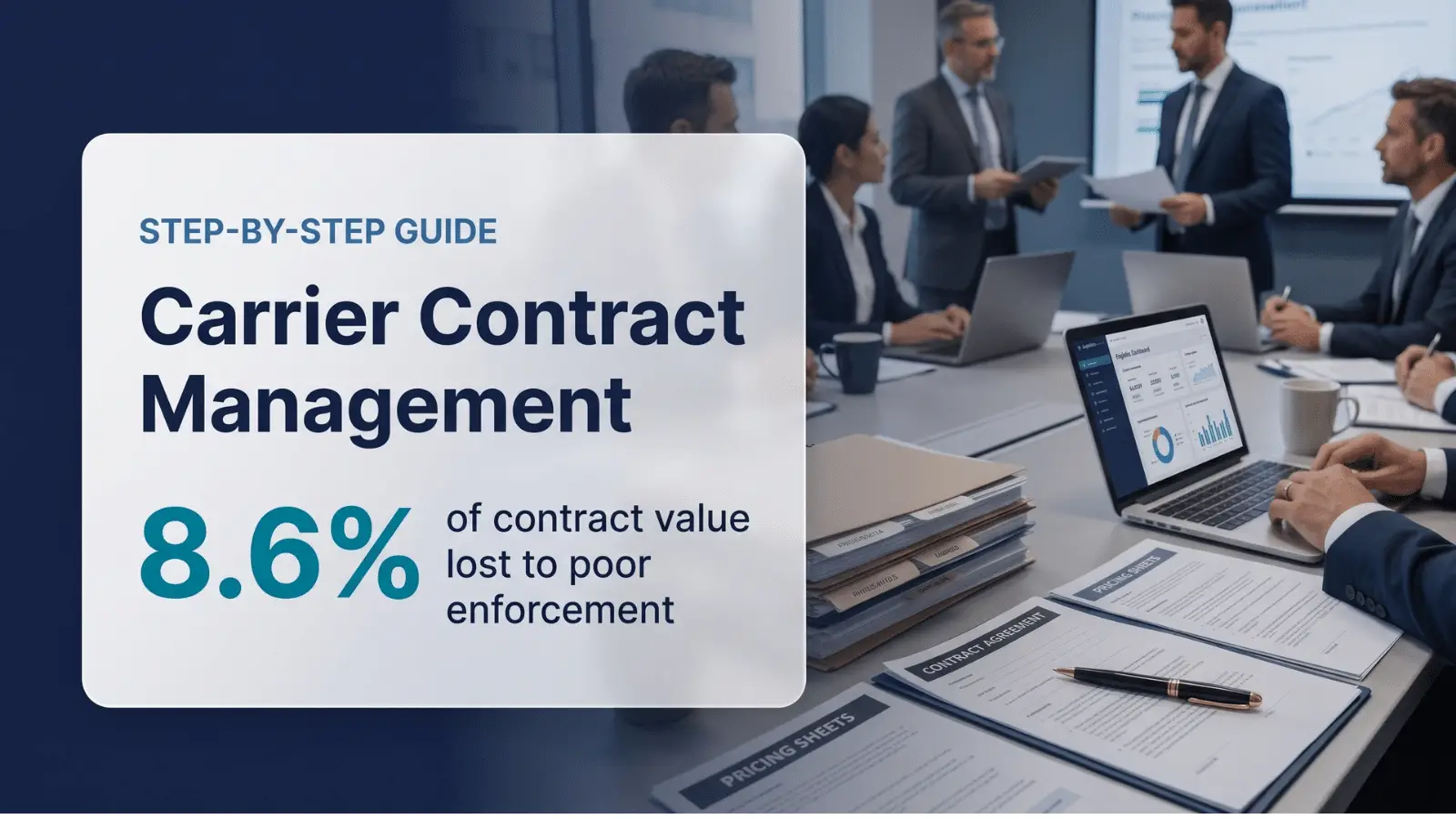
According to Deloitte research on contract management lifecycle performance, organizations lose an average of 8.6% of their total contract value due to poor contract management practices.
For a company spending $20 million annually on freight, that is $1.72 million disappearing not because rates were negotiated poorly, but because those rates are never systematically enforced at the invoice level.
Key takeaways:
- Organizations lose an average of 8.6% of total contract value when contract terms are not enforced at the invoice level (Deloitte).
- The Execution Gap, the disconnect between a negotiated carrier contract and what finance actually pays, is the primary source of preventable freight cost leakage.
- Contract lifecycle management software centralizes contracts but does not audit invoices line by line or recover credits when carriers overbill.
- Closing the Execution Gap requires combining contract data with invoice-level auditing, dispute resolution expertise, and continuous SLA tracking.
What is carrier contract management?
Carrier contract management is the structured process of governing all financial and operational agreements between a shipper and its freight carriers, spanning every mode from small parcel and LTL through truckload, international air, and ocean. It begins at the negotiation table and runs continuously through payment, performance review, and contract renewal.
The term transportation contract management is used interchangeably in enterprise procurement contexts. What distinguishes effective management from ineffective management is not whether contracts exist but whether their terms are enforced at the point of every invoice. For companies moving significant freight volume, the practical scope includes:
- Negotiating base rates by lane, mode, and volume tier
- Loading contracted rates into systems of record so invoices can be matched against them
- Auditing freight invoices line by line to catch discrepancies before payment
- Recovering credits when carriers overbill or miss SLA commitments
The five stages of carrier contract management
The five stages are carrier rate negotiation, contract execution and documentation, rate loading and system configuration, invoice auditing and enforcement, and carrier performance tracking with renewal. Most organizations invest heavily in the first two and neglect the final three, which is precisely where financial leakage concentrates.
Carrier rate negotiation is where contracts begin. Procurement benchmarks market rates, issues RFPs, and locks in pricing by lane, mode, and volume commitment.
Contract execution and documentation is where fragmentation starts. Deloitte research found that in large organizations, contract-related data sits across an average of 24 different systems, eliminating any single source of truth for invoice auditing.
Rate loading and system configuration is the most commonly overlooked stage. When negotiated rates are not loaded correctly into the TMS or ERP, especially after mid-contract amendments communicated by email, every subsequent invoice carries error risk.
Invoice auditing and enforcement is where contracted terms are either honored or ignored. The Execution Gap lives at this stage, and freight audit and payment services deliver their primary value here: matching every invoice line against contracted rates and initiating disputes for discrepancies.
Carrier performance tracking and renewal converts SLA data into negotiating leverage. Organizations that track performance continuously enter renewals with documented evidence rather than estimates.
What are the most common challenges in freight contract management?
The three most common challenges are data fragmentation across internal systems, the Execution Gap between negotiated terms and invoice payment practices, and uncontrolled accessorial charges applied without clear contractual basis.
Data fragmentation means the contract lives in one system, invoice processing runs in another, and rate amendments get lost between them. Accessorial charges (detention, liftgate, residential delivery, extended area surcharges) are often defined vaguely, giving carriers billing latitude beyond what was intended. For a breakdown of how to negotiate and audit these fees, see our guide to managing accessorial charges. Manual spreadsheet maintenance compounds both by creating a single point of failure for rate accuracy.
What are the key components of a transportation contract?
A complete transportation contract contains four core components: base rates, an accessorial schedule, service level agreements, and liability terms. Each creates a financial obligation on the carrier and an auditing responsibility on the shipper.
| Contract component | What it covers | Where it most often breaks down |
|---|---|---|
| Base rates | Per-mile, per-hundredweight, or per-lane pricing by mode | Mid-contract amendments not loaded into TMS or ERP |
| Accessorial schedule | Detention, fuel surcharge, residential delivery, liftgate | Vague definitions give carriers billing latitude |
| Service level agreements | On-time delivery, damage thresholds, claims response windows | Credits for missed SLAs are rarely claimed without active tracking |
| Liability terms | Cargo liability limits, declared value, claims filing windows | Missed filing deadlines forfeit legitimate recovery rights |
When cargo is lost, damaged, or delayed, a structured freight claims management process is what converts the liability terms in the contract into actual recovered dollars.
How does the execution gap cause freight billing errors?
The Execution Gap is the operational disconnect between the contract terms procurement negotiated and the process finance uses to approve and pay freight invoices. It persists regardless of how sophisticated a company’s contract storage or TMS platform is.
The gap opens in predictable ways: a carrier amendment communicated by email never gets entered into the system; a fuel surcharge index changes at the carrier’s quarterly update with no reconciliation against the contracted methodology; a volume tier is applied incorrectly because the rate table was not updated after renewal. Each discrepancy, paid without audit, becomes a permanent loss.
The most common specific causes include:
- Rate tables not updated after a contract renewal or mid-term amendment
- Carrier-applied accessorial charges not explicitly defined in the contract
- Volume tier misapplication, where the carrier invoices above the shipper’s actual tier
- SLA credit obligations the carrier never self-applies and the shipper never claims
U.S. business logistics costs reached $2.58 trillion in 2024, representing 8.8% of GDP (CSCMP 36th Annual State of Logistics Report, 2025). At Deloitte’s estimated 8.6% leakage rate, a company with $30 million in freight spend is losing approximately $2.58 million annually to gaps that systematic auditing would catch.
Software vs. freight audit and payment: what each actually does
Contract lifecycle management software and TMS platforms centralize carrier contracts, automate renewal alerts, standardize rate storage, and provide version control across amendments. They do not automatically audit freight invoices against those rates, initiate carrier disputes for overbilled charges, or recover credits for missed SLA commitments. These are complementary tools, not competing ones.
| Capability | CLM / TMS software | Freight audit and payment |
|---|---|---|
| Centralized contract storage | Yes | Yes |
| Rate loading and version control | Yes | Yes |
| Renewal alerts and deadline tracking | Yes | Yes |
| Line-by-line invoice audit against contracted rates | Limited / manual | Yes |
| Automated discrepancy flagging | Partial | Yes |
| Carrier dispute resolution and credit recovery | No | Yes |
| SLA miss credit tracking and recovery | No | Yes |
| Accessorial charge validation | Limited | Yes |
| Human expertise for complex billing disputes | No | Yes |
A TMS or CLM platform solves the document organization problem. Freight audit and payment services solve the financial enforcement problem. Companies using only the first without the second have organized the problem; they have not solved it. See how mid-market and enterprise shippers reduce transportation spend by combining both.
How often should you renegotiate freight contracts?
Most carriers expect annual formal renegotiations, but quarterly performance reviews and continuous invoice auditing create negotiating leverage at any point in the contract cycle. A carrier missing on-time commitments 18% of the time is a fundamentally different counterpart than one meeting SLAs consistently. Without ongoing tracking, those situations look identical at renewal time. Organizations that enter renegotiations with documented evidence of overbilling and missed SLAs consistently produce better rate outcomes. With 56% of leading chief economists surveyed by the World Economic Forum expecting global economic conditions to weaken (World Economic Forum, January 2025), maintaining that data record between renewals is more important than ever.
Frequently asked questions about carrier contract management
What is carrier contract management?
Carrier contract management is the end-to-end process of negotiating, documenting, loading, auditing, and renewing pricing agreements with freight carriers. It covers base rates, accessorial schedules, service level agreements, and liability terms across all transportation modes. The goal is to ensure every invoice paid reflects the rates and conditions that were actually negotiated.
What are the five stages of carrier contract management?
The five stages are carrier rate negotiation, contract execution and documentation, rate loading and system configuration, invoice auditing and enforcement, and carrier performance tracking with renewal. The auditing and enforcement stage is where most financial leakage occurs, because few organizations systematically match every invoice against contracted rates before approving payment.
What is the difference between a spot rate and a contract rate?
A spot rate is a one-time market price for a single shipment, typically used when no committed volume agreement exists. A contract rate is a negotiated price locked in for a defined term and volume commitment. Contract rates provide cost predictability but require active invoice auditing to ensure carriers consistently honor the agreed-upon terms on every shipment.
What are the most common challenges in freight contract management?
The three most common challenges are data fragmentation (Deloitte research found companies manage contract data across an average of 24 internal systems), the Execution Gap between negotiated terms and actual invoice payment practices, and uncontrolled accessorial charges applied without clear contractual basis. Manual spreadsheet management compounds all three by creating a single point of failure for rate accuracy.
What is the difference between a transportation contract and a pricing agreement?
A transportation contract is a legally binding document with defined SLAs, liability limits, dispute resolution clauses, and enforceable remedies for both parties. A pricing agreement, sometimes called a rate confirmation, is a carrier’s pricing sheet with limited enforceability on service performance. Without a full contract, shippers often lack legal recourse when carriers miss commitments or apply unauthorized charges.
Carrier contracts are not the problem. In most organizations, the rates procurement negotiates are reasonable, the terms are defensible, and the documents are filed somewhere accessible. What breaks down is the connection between those documents and the payment process running every day after the ink is dry.
Closing the Execution Gap requires a process that matches every invoice to every contracted term, surfaces every discrepancy, and initiates disputes before payment is issued. If your team is managing carrier contracts across spreadsheets and email threads, our freight audit and payment services are built to close that gap. Get a free assessment to see what it looks like in dollar terms.