

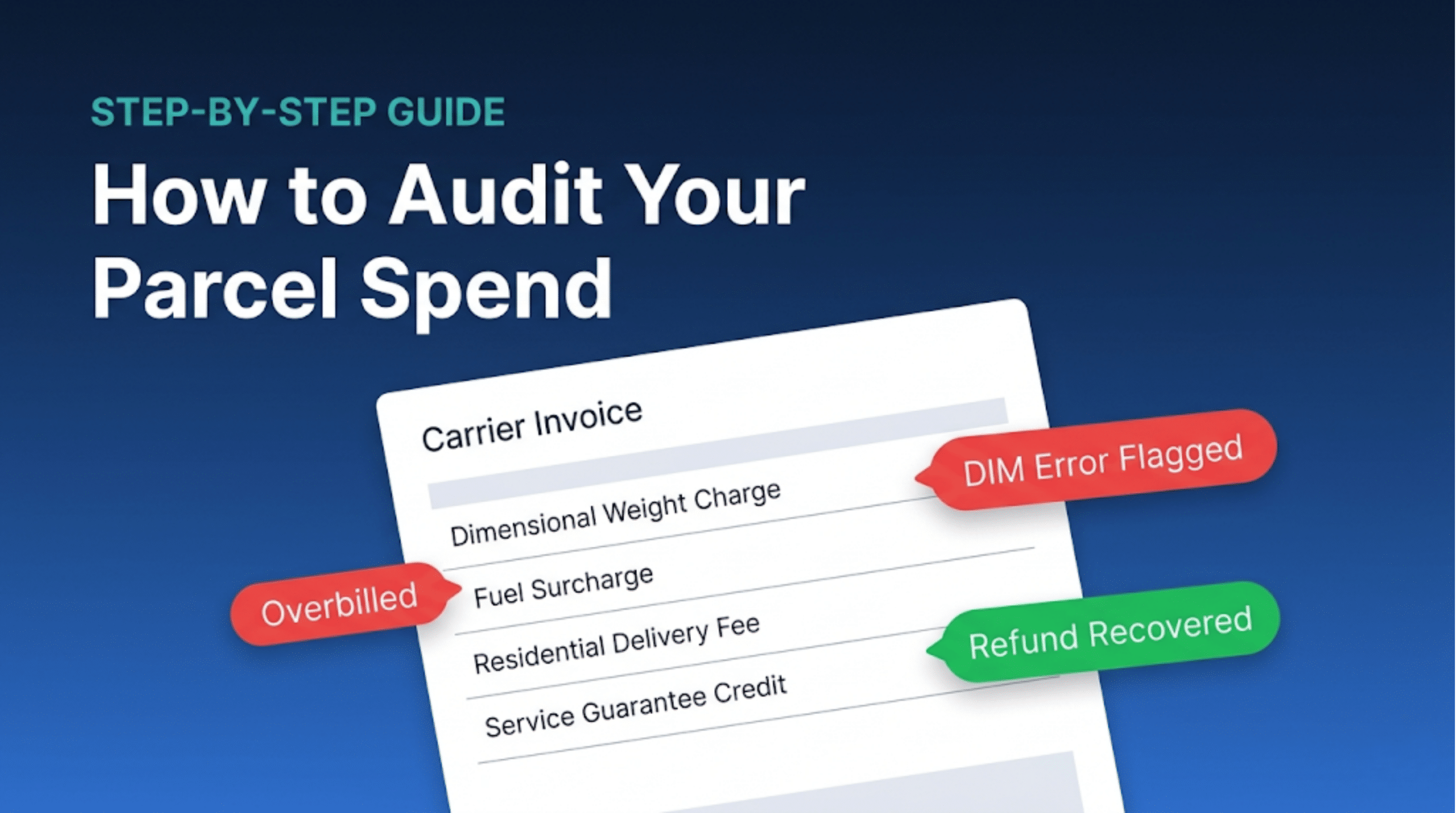


A parcel audit is a systematic review of every carrier invoice line item, checking for billing errors, service guarantee violations, and accessorial fee misapplications that result in overcharges. Industry research consistently finds that automated freight audit platforms achieve approximately 95% invoice accuracy compared to roughly 70% for manual review. For companies spending millions annually with UPS or FedEx, that accuracy gap translates directly into unrecovered cash. In one recent engagement, Zero Down recovered $392K in parcel savings for a medical supply distributor by identifying errors the internal team had missed for years.
Key takeaways:
- A parcel audit identifies carrier billing errors, including late delivery fee violations, incorrect dimensional weight charges, duplicate invoices, and misapplied accessorial fees that most shippers never catch.
- Automated parcel audit platforms consistently achieve higher invoice accuracy than manual review processes, while reducing auditing operational costs significantly.
- Beyond refund recovery, the most valuable output of a parcel audit is spend intelligence: data that gives you real negotiating leverage when renegotiating carrier contracts.
- Last-mile delivery accounts for a substantial share of total shipping expenses, making parcel spend one of the highest-impact areas for supply chain cost reduction.
What is a parcel audit?
A parcel audit is the process of reviewing carrier invoices from UPS, FedEx, USPS, or regional carriers line by line to identify billing errors, service failures, and overcharges. When errors are confirmed, the auditor files claims on the shipper’s behalf and reconciles refund credits against future invoices.
A single invoice for a mid-volume shipper can carry thousands of line items: base freight charges, fuel surcharges, residential delivery fees, dimensional weight adjustments, delivery area surcharges, and address correction fees. Each charge is governed by a combination of the carrier’s published tariff, your negotiated rate addendum, and the carrier’s internal accessorial logic. Any of those inputs can be wrong. With U.S. business logistics costs now at $2.58 trillion annually (CSCMP/Kearney, 2025), parcel shipping remains one of the largest and least-scrutinized line items in most transportation budgets.
The most common parcel invoice errors
Parcel invoice errors fall into four categories: late delivery service failures, incorrect dimensional weight calculations, duplicate charges, and misapplied accessorial fees. Together, these errors typically account for 1% to 10% of a shipper’s total parcel spend.
| Error type | What it is | Recovery difficulty |
|---|---|---|
| Late delivery service failure | Package delivered after the guaranteed window (where carrier guarantee is active by service type) | Low, if filed within the claim window |
| Incorrect dimensional weight (DIM) | Volume-based weight applied instead of actual weight | Moderate, requires disputing the DIM calculation |
| Duplicate invoice | Same shipment billed twice | Low, straightforward deduction once identified |
| Residential delivery surcharge | Commercial address classified as residential | Moderate, requires address reclassification |
| Invalid fuel surcharge | Rate applied above what your contract allows | High, requires cross-referencing your rate agreement |
| Misapplied accessorial fee | Fee applied to a shipment that does not qualify | Moderate |
Two error types deserve particular attention. Carriers calculate dimensional weight by multiplying L x W x H and dividing by a DIM divisor (currently 139 for most UPS and FedEx commercial accounts). When carriers measure dimensions incorrectly, you pay for cubic inches of air. Service guarantee failures carry a hard deadline: UPS typically requires claims within 15 days of the scheduled delivery date. Miss that window and the refund is gone permanently. It is also important to note that service guarantee coverage varies by carrier and service type. For both UPS and FedEx, active guarantees apply only to select Air and International services; the UPS Ground and FedEx Ground money-back guarantees have both remained suspended since 2020 and have not been reinstated.
How does a parcel audit work?
A parcel audit works by ingesting carrier invoice data electronically, validating each charge against contracted rates and service guarantees, flagging discrepancies, filing claims, and reconciling refund credits. On an automated platform, this runs continuously against every invoice, not just a spot-checked sample.
The six stages of the process:
- Invoice ingestion: EDI files, portal downloads, or API feeds are pulled into the audit system and normalized across carriers.
- Rate validation: Each charge is matched against your negotiated rate card, including accessorial schedules, fuel surcharge tables, and DIM weight calculations.
- Service guarantee verification: Actual delivery timestamps are compared against guaranteed windows by service level and lane, for services where a guarantee is currently active.
- Claim filing: Confirmed discrepancies are submitted to the carrier. The audit provider tracks each claim and follows up on denied or stalled items.
- Credit reconciliation: Refunds appear as credits on future invoices. The platform reconciles credits against filed claims to verify the carrier paid correctly.
- Spend reporting: This is the step most audit pitches gloss over. The output becomes a spend intelligence dataset showing accessorial fee frequency, DIM variance by lane, and carrier on-time performance by service type. That data is the foundation for contract renegotiation.
Parcel invoice auditing vs. parcel spend management
Parcel invoice auditing is the tactical process of reviewing carrier bills and filing claims for overcharges. Parcel spend management is the broader strategy of using audit data, carrier performance analytics, and contract benchmarking to reduce total parcel costs over time.
Most companies start with auditing and evolve into spend management once they have a baseline of clean data. Auditing produces the evidence; spend management uses it to reduce what you get charged in the first place. Carrier contract negotiation is where the ROI compounds most significantly.
How much can you save with a parcel audit?
Most shippers recover between 1% and 10% of their total parcel spend through a formal audit program. The amount depends on carrier mix, invoice complexity, and whether service guarantee monitoring has been active.
For a company spending $5 million annually on parcel, a 3% recovery rate represents $150,000 in recaptured costs. Zero Down’s work with a medical supply distributor produced $392K in parcel savings from errors that had accumulated unchallenged for years. With last-mile delivery representing a substantial portion of total shipping expenses, the opportunity cost of not auditing continues to rise.
Should you audit parcel invoices manually or use a service?
Manual parcel auditing becomes impractical at scale. Once a shipper exceeds several hundred shipments per week, the combination of invoice complexity and data volume makes complete manual review unreliable by default. Automated audit services are the only way to achieve consistent, 100% invoice coverage at scale.
| Factor | Manual audit | Automated audit service |
|---|---|---|
| Invoice coverage | Partial, spot-checking only | 100% of invoice line items |
| Invoice accuracy | Lower, typically incomplete coverage | Substantially higher, consistent across all line items |
| Claim filing speed | Days to weeks | Within 24 to 48 hours of invoice receipt |
| Service guarantee monitoring | Difficult to maintain consistently | Automated per-shipment tracking |
| Auditing operational cost | High (staff time) | Significantly reduced |
| Data for contract negotiation | Minimal | Full spend analytics dataset |
| Scalability | Does not scale | Scales with shipment volume |
For companies managing parcel alongside LTL, truckload, or ocean freight, a comprehensive freight audit and payment platform covering all modes delivers more value than a parcel-only tool. Siloed auditing produces siloed data.
Using audit data for carrier contract renegotiation
Parcel audit data gives you documented evidence of your actual accessorial fee exposure, DIM weight variance by lane, service failure rates, and surcharge patterns. That evidence changes the negotiating dynamic at contract renewal.
Without it, you negotiate from general market benchmarks. With it, you negotiate from your own invoice history: exactly what you were charged, how often, and where carriers fell short on service commitments. For shippers ready to move from recovery to renegotiation, a deeper look at optimizing your UPS and FedEx contracts covers how to build a contract strategy from audit data.
FAQs
What is a parcel audit?
A parcel audit is a systematic review of carrier invoices from UPS, FedEx, USPS, or regional carriers to identify billing errors, service failures, and overcharges. Claims are filed on the shipper’s behalf to recover overpayments. Most shippers recover between 1% and 10% of their total parcel spend, depending on volume and carrier mix.
How do parcel audit services work?
Parcel audit services ingest carrier invoice data electronically, validate each charge against contracted rates and service guarantees, flag discrepancies, and file refund claims with the carrier. The provider tracks claim status and reconciles credits applied to future invoices. Most services operate on a gain-share model, so you pay nothing unless the provider recovers something.
What is a service failure in parcel shipping?
A service failure occurs when a carrier delivers a package outside its guaranteed delivery window. Under eligible service types, this can entitle the shipper to a full freight charge refund. Service guarantee coverage varies significantly by carrier and service level. Both UPS Ground and FedEx Ground money-back guarantees have remained suspended since 2020 and have not been reinstated; active guarantees apply to select Air and International services only. Claim deadlines also differ by carrier: UPS requires claims within 15 days of the scheduled delivery date, while FedEx requires claims within 15 days of the invoice date for invoiced accounts. Missing either window forfeits the refund permanently.
How much can you save with a parcel audit?
Most shippers recover between 1% and 10% of their total parcel spend through a formal audit program. The amount depends on volume, carrier mix, and contract complexity. For a company spending $5 million annually on parcel, a 3% recovery represents $150,000. For high-volume shippers with complex accessorial profiles, the recoverable amount scales proportionally.
What are the most common parcel invoice errors?
The most common errors include late delivery service failures, incorrect dimensional weight calculations, duplicate charges, residential surcharges applied to commercial addresses, and accessorial fees applied to ineligible shipments. Invalid fuel surcharge rates billed above contracted levels also occur frequently but are harder to catch without a direct cross-reference against your rate agreement.
Where to start with parcel spend auditing
The path from first audit to recovered credits typically takes weeks, not quarters. An audit provider ingests your invoice history, identifies recoverable errors, and begins filing claims. Most services operate on a gain-share model, so there is no upfront cost.
The bigger question is what you do with the data once auditing is running. Shippers who treat it purely as a refund mechanism leave the most significant value on the table. Spend intelligence applied to carrier contract negotiations is where error recovery becomes a permanent reduction in your rate structure.
Talk to the Zero Down team about what your carrier invoices may be hiding. Learn more about our automated parcel audit service.