

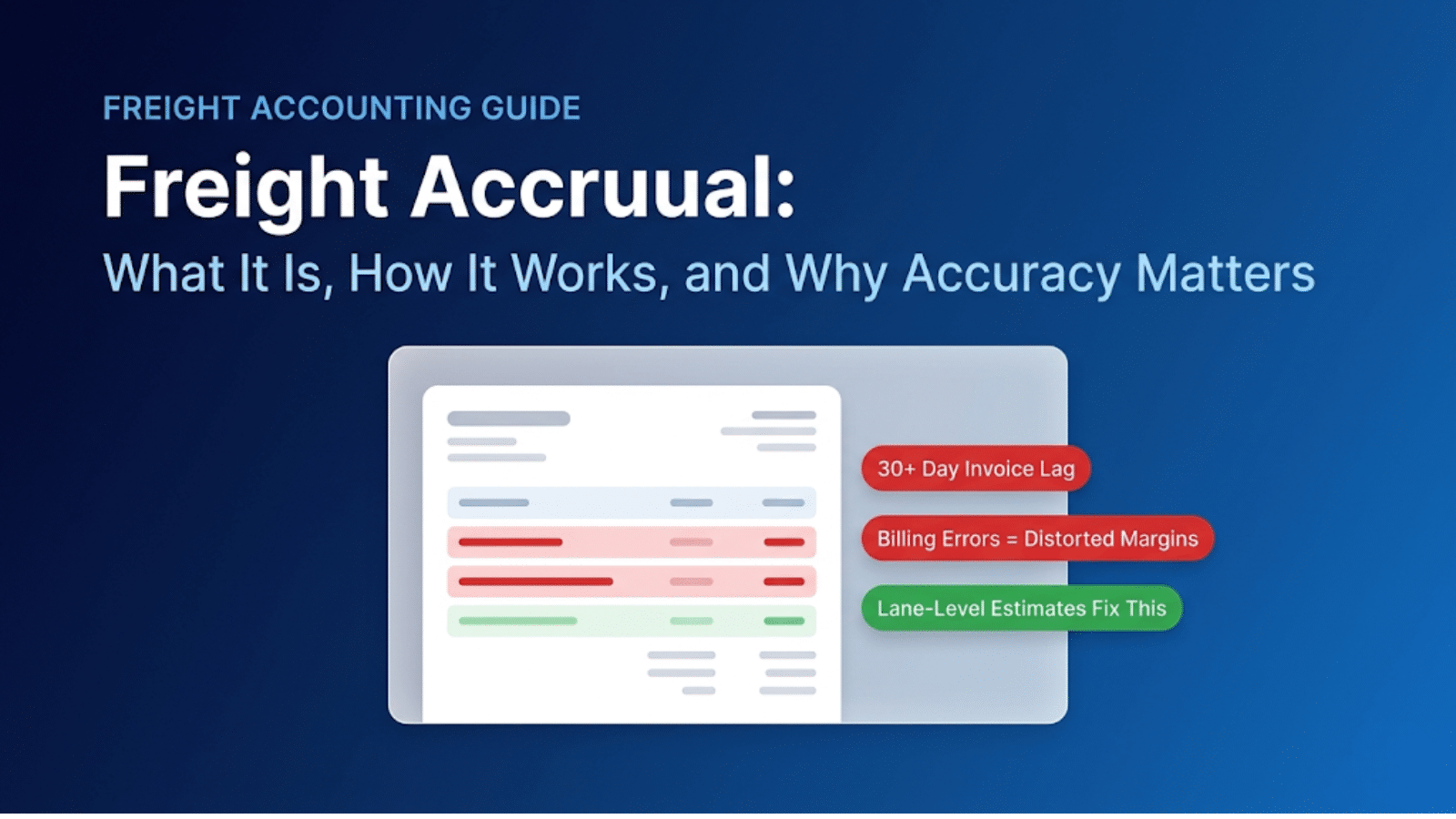


A freight accrual is an accounting entry that records the estimated cost of freight that has been shipped but has not yet been invoiced by the carrier. It appears on the balance sheet as a liability and is reversed when the actual invoice arrives. U.S. business logistics costs reached $2.58 trillion in 2024, representing 8.8% of national GDP (CSCMP State of Logistics Report, 2025). For companies with significant freight spend, even small accrual errors distort monthly financials, because carrier invoices routinely arrive 30 or more days after shipment.
Key takeaways:
- A freight accrual is an estimated liability posted when freight ships, but before the carrier invoice arrives, sometimes 30 or more days later.
- Industry research consistently finds that a meaningful share of freight invoices contain billing errors, misclassifications, or discrepancies, making accurate accruals the first line of defense against financial distortion.
- Flat-percentage accrual methods break down against volatile fuel surcharges and accessorial charges; lane-level estimates using contracted rates produce materially lower variances.
- Companies that improve freight spend visibility and audit rigor can reduce transportation costs by several percentage points annually, with savings that compound as audit data informs contract negotiations and carrier accountability.
What is a freight accrual in accounting?
A freight accrual is a liability entry recording the estimated cost of freight that has been shipped but has not yet been invoiced. It is posted to an accrued freight liability account and reversed when the actual invoice is received and matched, following the GAAP matching principle: expenses must be recognized in the period they are incurred, not when the bill arrives.
Accounts payable reflects invoices received and approved for payment. Accrued freight is the estimated liability for freight that has moved but has not yet been billed. Once the invoice arrives and is matched, the balance transfers between the two accounts.
Why do freight accruals create month-end problems?
Freight accruals become a month-end problem because carriers submit invoices 30 or more days after shipment. LTL carriers often bill within one to two weeks; international carriers and brokers often operate on longer billing and payment cycles that can extend well beyond 30 days. The close either waits for invoices or proceeds on estimates that may be materially wrong. Freight invoices regularly contain billing errors, misclassifications, or discrepancies, so teams are often waiting for invoices that will need to be disputed before payment can be approved.
Flat-percentage accrual methods compound this problem. A flat 5% or 10% of COGS works when rates are stable, but breaks under several common conditions:
- Fuel surcharges spike or drop mid-period, changing the effective rate on every shipment
- Carriers assess detention, re-delivery, liftgate, or re-weigh charges not captured in the base rate
- Spot rates diverge from contracted rates due to capacity shifts
- Product mix shifts toward heavier freight, changing cost profiles by mode
These unpredictable accessorial charges accumulate silently until invoices arrive, often producing large year-end write-offs.
How do you calculate a freight cost accrual?
Lane-level freight accruals use contracted rates, historical actuals by carrier, and mode-specific accessorial assumptions. Flat percentages of COGS are a fallback, not a best practice. The six steps:
- Pull the shipment record from your TMS. Extract origin, destination, mode, carrier, and weight for each load that has tendered or shipped.
- Apply the contracted rate for that lane. Use the rate in your carrier contract or TMS rate table; if no contracted rate exists, use the six-month average actual.
- Add a historical accessorial buffer. Using 12 months of actuals for that lane, calculate average accessorial charges as a percentage of base rate and apply to the estimate.
- Create the accrual entry in your ERP. Debit freight expense; credit accrued freight liability. Tag the entry with GL code, cost center, and shipment reference number.
- Reverse the accrual when the invoice arrives. Post the actual invoice to accounts payable, reverse the estimated entry, and record the variance. Variances below your defined threshold are absorbed in the current period; variances above it are reviewed for root cause.
What should a freight accrual reconciliation workflow look like?
A freight accrual reconciliation workflow tracks each shipment through a closed-loop sequence, eliminating unresolved liabilities and supporting a clean month-end close.
Load tendered → Estimated cost logged in TMS → Accrual created in ERP → Invoice received → Variance identified → Accrual reversed and variance disposed
At month-end, generate an accrual-to-invoice match report, identify open items, flag variances above threshold, and resolve before the close. Entries unmatched within 60 to 90 days should be reviewed for write-off. Freight cost allocation should happen at accrual creation, not after close; a TMS that captures cost center at the shipment level auto-populates GL fields and removes manual reclassification.
Three failures account for most reconciliation problems: entries created without a shipment reference number; accruals built at the invoice level rather than the load level; and GL codes that do not align with cost center structure.
Freight accrual method comparison
| Method | Accuracy | Scalability | Best for |
|---|---|---|---|
| Flat % of COGS | Low | High | Companies with fewer than 500 shipments per month and stable rates |
| Mode-average estimate | Medium | Medium | Companies managing multiple modes without a TMS |
| Lane-level contracted rate | High | Medium | Companies with a TMS and carrier contracts on file |
| Automated freight audit platform | Very high | Very high | Companies with high shipment volume or complex accessorials |
What are freight accounting best practices for month-end close?
Freight accounting best practices for month-end close center on completing the accrual cycle before the books close, maintaining an audit trail from shipment to payment, and using systematic reconciliation to prevent unresolved variances from carrying forward. Freight audit and invoice accuracy have emerged as a front-line cost-control priority for supply chain and finance leaders navigating persistent transportation spend volatility.
Five practices separate companies that close cleanly from those that do not:
- Accrue by load, not by invoice. One entry per shipment prevents matching confusion when carriers consolidate multiple loads onto a single bill.
- Set a weekly accrual cadence. Processing weekly reduces end-of-month volume and keeps rate data current.
- Standardize GL coding rules in writing. Undocumented conventions create variation across team members and complicate audits.
- Define your variance threshold as policy. A documented threshold prevents arbitrary period-to-period treatment.
- Maintain a rolling 12-month variance report by carrier and lane. This becomes the input for better accrual estimates and carrier contract negotiations.
When does manual freight accrual management stop making sense?
Manual freight accrual management reaches its limit when shipment volume exceeds a few hundred loads per month, when accessorials are frequent and variable, or when close consistently takes more than two to three days.
Watch for these signs that the current process has exceeded its capacity:
- Year-end accrual write-offs large enough to require explanation to leadership
- Monthly variances consistently exceeding 10% to 15% of the total estimated freight
- Finance team members are spending the majority of the close week on reconciliation
- Carriers are contacting AP about late payment because invoices are sitting unmatched
An automated freight audit and payment process handles this differently: accruals are generated from TMS shipment data, invoices are pre-audited before payment, variances are flagged in real time, and GL-ready output exports to the ERP automatically.
Frequently asked questions about freight accruals
What is a freight accrual in accounting?
A freight accrual is a liability entry recording the estimated cost of freight that has shipped but has not yet been invoiced by the carrier. It is posted to an accrued freight liability account and reversed when the actual invoice is received and matched to the shipment record. It follows the GAAP matching principle.
How do you calculate a freight cost accrual?
Calculate freight accruals using lane-level estimates based on contracted carrier rates plus a historical accessorial buffer for that lane. Pull the shipment record from your TMS, apply the contracted rate, add the accessorial buffer, and post the entry. Flat percentages of COGS are less accurate when fuel surcharges or accessorial charges fluctuate significantly.
Is accrued freight an expense or a liability?
Accrued freight is both. The freight expense is recorded on the income statement in the period the shipment occurred. The corresponding accrued freight liability appears on the balance sheet until the actual carrier invoice is received, at which point the accrual is reversed and the invoice is posted to accounts payable.
What is the difference between accounts payable and accrued freight?
Accounts payable reflects confirmed freight invoices that have been received, verified, and approved for payment. Accrued freight is an estimated liability for freight that has shipped but has not yet been invoiced. Once the carrier invoice arrives and is matched to the accrual, the balance transfers from accrued freight to accounts payable.
How do you reconcile a freight accrual variance?
Match each accrual entry to the corresponding carrier invoice using a shared shipment reference number. Calculate the difference between estimated and actual cost. Variances below your documented materiality threshold are absorbed in the current period. Variances above it are reviewed for root cause: a rate table error, an accessorial excluded from the estimate, or a carrier billing error requiring dispute.
When should freight costs be recorded in accounting?
Freight costs should be recorded in the period the shipment occurred, not when the carrier invoice arrives. Under GAAP, expenses must be recognized when incurred. For freight that moves in one accounting period but is invoiced in the next, an accrual entry captures the estimated cost in the correct period and is reversed when the actual invoice is posted.
Should freight-out be considered COGS or an operating expense?
Freight-out, the cost of delivering goods to customers, may be classified as either an operating expense or within cost of goods sold. GAAP does not mandate a single treatment, and practice varies by industry and company policy. Whichever treatment is chosen, it should be applied consistently period to period and disclosed in financial notes if the amount is material.
Getting freight accruals right is a direct input to accurate margin reporting, carrier contract negotiations, and cash flow forecasting. For high-volume shippers, the manual accrual cycle is often where accuracy erodes first. Companies that address it systematically have found that surfacing hidden freight costs through rigorous audit and reconciliation can recover hundreds of thousands of dollars annually.
If your team is spending significant time on freight accrual reconciliation with inconsistent results, Zero Down Supply Chain Solutions can show you how an automated freight audit and payment process closes the gap between logistics operations and the finance back office.